
Understanding UDL: A Foundation for Inclusive Design
Universal Design for Learning (UDL) is a framework that helps create flexible, inclusive learning experiences by recognizing that all learners engage with content in different ways.
Instead of designing for an “average” learner, UDL encourages us to design for variability from the start, so more people can access, understand, and engage with learning.
What is Universial Design for Learning?
UDL is built on a simple idea:
Learners are not the problem, design is.
When learning environments are designed with flexibility, clarity, and accessibility in mind, more people can succeed.
UDL helps designers:
- reduce barriers
- support different learning preferences
- create more equitable learning experiences
The Three Principles of UDL
UDL is organized into three core principles. Together, they help ensure learning is accessible, engaging, and meaningful.
Engagement:
Why learners learn
What this means:
Engagement focuses on motivation and interest. Not all learners are motivated in the same way, so we need to provide different ways to spark and sustain engagement.
In practice:
- Offer choice in activities or topics
- Use real-world, relevant examples
- Include interactive or scenario-based learning
- Allow flexible pacing
Why this matters:
When learners are engaged, they are more likely to persist, participate, and connect with the material.
Representation:
How learners access information
What this means:
Representation focuses on how information is presented. Learners perceive and process information differently.
In practice:
- Provide text, audio, and visual formats
- Use captions, transcripts, and alt text
- Simplify complex information with visuals or diagrams
- Highlight key information clearly
Why this matters:
When information is presented in multiple ways, more learners can access and understand it.
Action & Expression:
How learners show what they know
What this means:
This principle focuses on how learners demonstrate understanding. Not everyone expresses knowledge in the same way.
In practice:
- Offer multiple ways to complete assignments
- Allow written, visual, or verbal responses
- Include reflection or applied activities
- Provide tools and scaffolds for success
Why this matters:
When learners can express understanding in different ways, they can demonstrate what they truly know.
What UDL looks like in Practice
UDL is not about adding more; it’s about designing smarter.
Small design decisions can make a big difference.
- Break content into smaller, clear sections
- Offer both written and audio instructions
- Design intuitive navigation
- Reduce unnecessary complexity
UDL Guidelines Overview
A visual breakdown of how UDL principle translate into actionable design checkpoints.
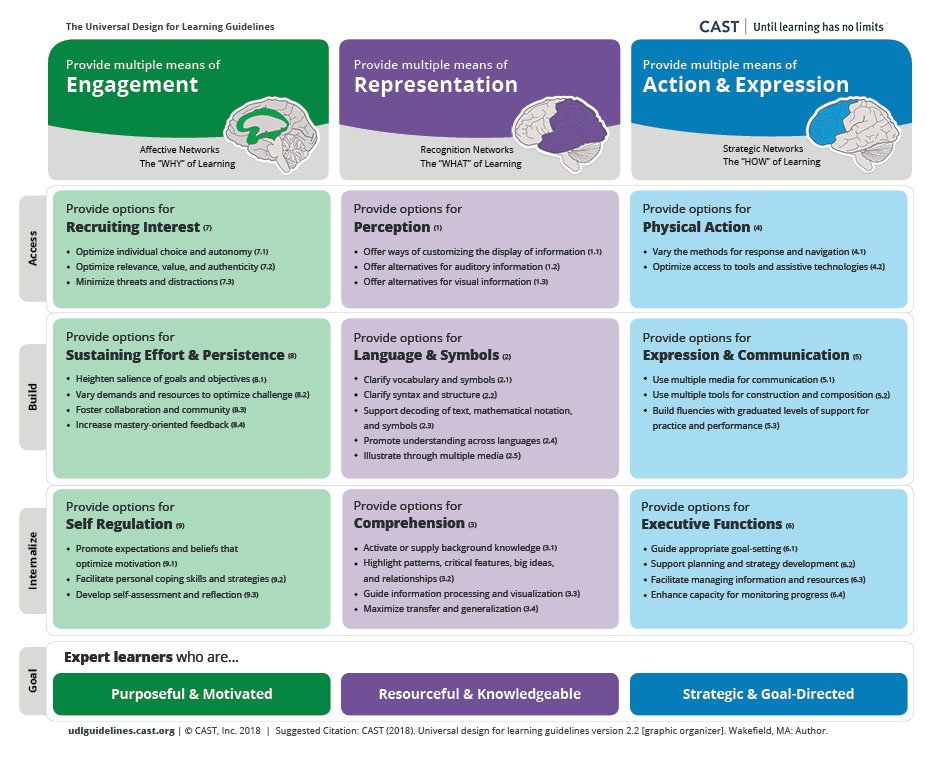
The UDL Guidelines, developed by CAST, provide a detailed framework for applying these principles in practice.
They break each principle into checkpoints that help guide design decisions.
Explore UDL Resources
If you’re getting started with UDL, these resources can help you move from understanding UDL to applying it in your own work.
Why UDL Matters to me
UDL is not just a framework I use; it’s a perspective that shapes how I design.
As someone who has experienced learning barriers firsthand, I believe accessibility should be built into design from the beginning, not added later.
Designing with UDL allows me to:
- simplify complex systems
- support diverse learners
- create learning that is clear, usable, and human-centered